
Owner Mentality and Revenue Planning: The Secret Sauce of Growth
- Anil Kale
- Mar 10
- 8 min read
Why Owner Mentality Business Scaling Separates Thriving Companies from Stagnant Ones

Owner mentality business scaling is the practice of combining a founder's drive, accountability, and front-line obsession with the systems and leadership structures needed to grow beyond what any one person can manage alone.
Here's what that looks like in practice:
Think like an owner, not an operator - Make decisions based on long-term value, not short-term comfort
Build systems, not dependencies - Processes should run without you in the room
Delegate with intention - Move from doing every task to enabling others to do them better
Obsess over the front line - Stay connected to customers and employees even as you scale
Evolve your leadership role - Shift from player to coach as the business grows
Most founders never make this shift. That's not an opinion - it's a pattern backed by hard data.
Only 5% of US businesses ever grow past $1 million in annual revenue. And among companies that do grow, 85% of the problems that eventually stop that growth are internal - not market forces, not competition, not bad luck. The culprit is almost always the same: complexity created by growth itself.
Industry research on what is known as the "growth paradox" puts it plainly - the very act of scaling creates internal friction that kills further scaling. Teams grow. Processes multiply. Decision-making slows. And somewhere in that mess, the founding energy that made the business special quietly disappears.
The businesses that break through this pattern share one thing: they maintain what researchers call a Founder's Mentality - an insurgent drive, a deep connection to the front line, and an owner's mindset that treats every dollar and every decision as if the whole company depends on it. Because it does.
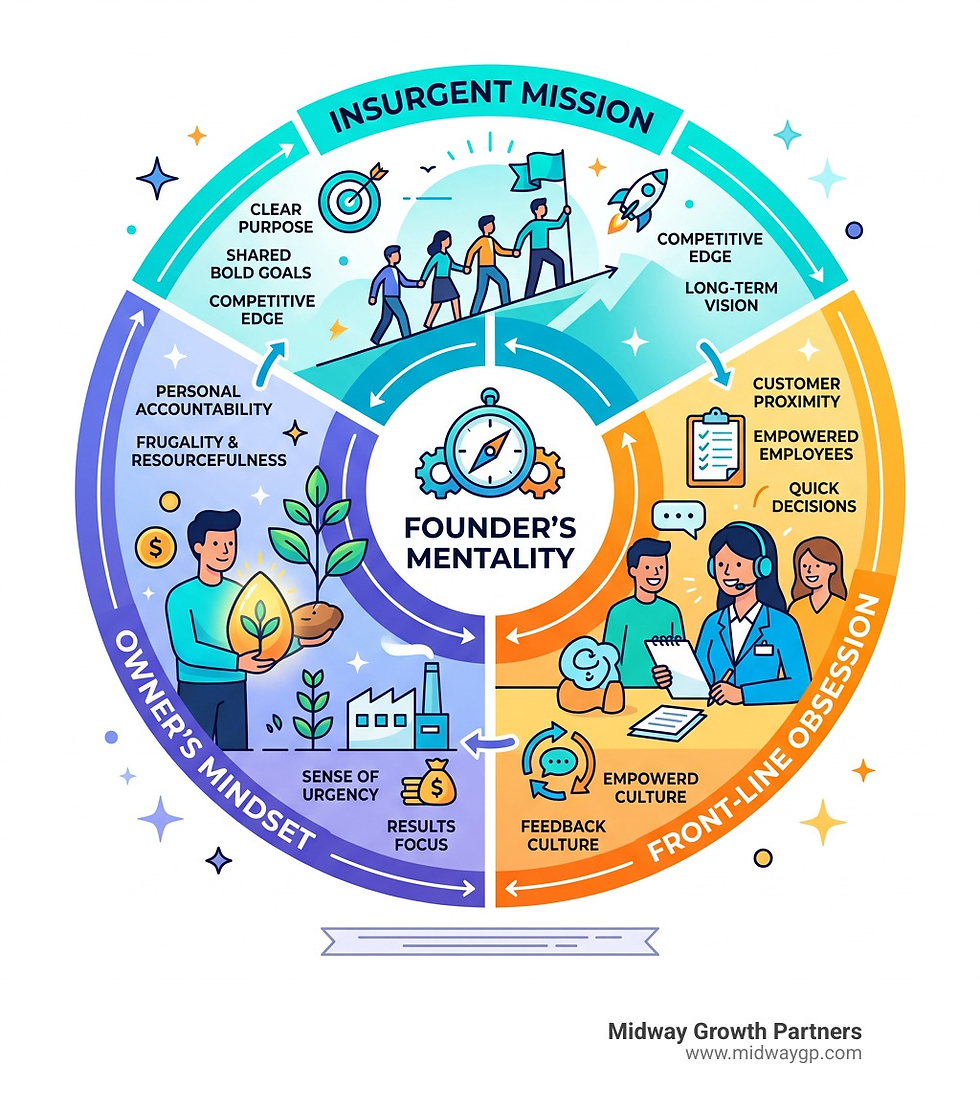
The Founder’s Mentality: Overcoming the Growth Paradox
At Midway Growth Partners, we see it daily: growth creates complexity, and complexity is the silent killer of growth. This is the "Growth Paradox." To overcome it, we must look at the core elements of the Founder's Mentality. This isn't just about the person who started the company; it’s a specific organizational state of mind.
There are three pillars to this mindset:
Insurgent Mission: The feeling that you are at war with your industry on behalf of underserved customers. You aren't just selling a product; you are fixing a fundamental wrong in the market.
Front-line Obsession: A relentless focus on the people who actually interact with customers. In a scaling business, the "heroes" should be the sales reps and customer success agents, not the executives in corner offices.
Owner’s Mindset: A visceral dislike of bureaucracy and a commitment to speed. It’s about acting as if every dollar spent is your own.
When companies lose these traits, they drift toward becoming "struggling incumbents"—large, slow, and disconnected. Only about 7% of companies manage to become "scale insurgents." These rare gems maintain their agile, founder-led soul while leveraging the resources of a massive corporation. Interestingly, these few companies represent more than 50% of the net value created in the stock market each year.
Navigating the Three Crises of Owner Mentality Business Scaling
As we help businesses navigate their revenue journey, we've observed that 80% of all major swings in company value occur during three predictable crises. Industry research shows these are:
Overload: This happens during rapid growth when the internal systems break. The founder is overwhelmed, and the original "special sauce" starts to taste a bit off because the team can't keep up with the pace.
Stall-out: Growth slows down as the organization becomes complex and bureaucratic. The "westward winds" of hierarchy and middle management begin to drown out the voice of the customer.
Free fall: The company loses its core relevance. This is the most dangerous stage, where the business stops growing entirely and starts losing market share.
Understanding these crises is the first step in owner mentality business scaling. By identifying which phase you are in, you can implement the right systems to pivot back toward insurgency.
The Difference Between P&L Thinking and Scale Thinking
Many founders get stuck in what we call "P&L Thinking." They are obsessed with the current month's profit and loss statement, leading to a cost-cutting obsession. While fiscal responsibility is good, over-focusing on short-term margins can trap you.
Scale Thinking, on the other hand, is an investor's mindset. It’s about growth leverage. Instead of asking "How much does this cost?", a scale-minded leader asks "What is the long-term value of this investment?"
Feature | P&L Business (Operator) | Scale Business (CEO) |
Primary Focus | Cost-cutting & short-term margins | Growth leverage & long-term value |
Control | Founder-controlled (Bottleneck) | Systems-driven (Empowered) |
Decision Making | Based on "gut" and fear | Based on data and strategy |
Pricing | Underpriced to "win" deals | Premium pricing for better ICP |
Team | "Doers" following orders | Leaders owning outcomes |
Shifting from Operator to CEO: Breaking the $1M Glass Ceiling
Breaking the $1 million revenue mark is less about your product and more about your psychology. Statistics show that among firms starting with less than $100,000 in revenue, only a tiny fraction ever reach the $1M milestone. Why? Because the "Operator Trap" is incredibly seductive.
In the early days, being an operator—the person who does everything—is a survival skill. But as you scale, that same skill becomes a ceiling. We call this "control addiction." Founders often feel that no one can do the job as well as they can, so they refuse to delegate. This creates a bottleneck that prevents the company from breathing.
This leads to "success anxiety." As the business grows, the founder feels more stress, not more freedom. A staggering 72% of entrepreneurs report mental health concerns, often stemming from this feeling of being "chained to the chaos" of their own creation.
From Basketball to Football: The Systems-Driven Owner Mentality Business Scaling
A great analogy for owner mentality business scaling is the shift from basketball to football.
Basketball is a "strong-link" sport. One superstar (the founder) can carry the whole team to a championship. If the founder is "on," the business wins.
Football is a "weak-link" sport. It doesn't matter how good your quarterback is if the offensive line lets him get sacked every play. Success depends on every person executing their specific role perfectly.
Once a company passes roughly 70 employees, it must become a "football team." You can no longer rely on founder heroics. You need playbooks (SOPs) over inboxes. If a key decision is trapped in your email, you haven't scaled; you've just built a very large, very fragile job for yourself.
The Delegation Paradox and Psychological Ownership
A 2023 study in Applied Psychology found that founders must "recalibrate their venture-targeted psychological ownership" to grow. This is the Delegation Paradox: to gain more control over your company's future, you must give up control over its daily tasks.
To break free, we recommend:
Shifting from Creator to Conductor: Stop writing the music; start leading the orchestra.
Creating "Failure Budgets": Allow your team to make small mistakes. It’s the only way they—and the business—will learn.
Feedback Loops over Approvals: Instead of approving every marketing post, set brand guidelines and review the results weekly. This empowers the team while maintaining quality.
The Four Phases of Scaling Leadership and Culture
Scaling requires the leader to evolve through four distinct phases. If you stay in Phase 1 while your revenue is at Phase 3 levels, the business will eventually implode.
Doer to Delegator: You move from doing the work to documenting the work so others can do it.
Manager to Leader: You stop managing tasks and start leading people. This requires high Emotional Intelligence (EI) and a clear vision.
Leader to Culture Architect: You realize that you can't be in every room, so you build a culture that makes the right decisions for you.
CEO as Chief Enabler: Your primary job is now removing obstacles for your leadership team and developing the next generation of talent.
Institutionalizing an Owner Mentality Business Scaling Framework
How do you make "owner mentality" part of the company's DNA? You institutionalize it. This means moving from "unscalable founder" habits to repeatable models.
Define Non-Negotiables: These are the core behaviors that represent your founding mission. They aren't just posters on the wall; they are the standards by which everyone is hired, fired, and promoted.
Front-line Empowerment: Give the people closest to the customer the authority to make decisions. If a customer has a problem, the front-line employee should have the "owner-like" power to fix it immediately.
Talent Density: As you scale, the "cost" of a B-player increases exponentially. You must ruthlessly pursue A-players who share the insurgent mission.
For more on how to build this environment, The Leader's Guide to Corporate Culture offers excellent frameworks on aligning strategy and execution.
Practical Steps to Audit and Institutionalize Growth
At Midway Growth Partners, we use several models to help our clients move from "chaotic growth" to "true scale."
The Two Futures Model Every day, you are choosing between two futures:
Drift: You react to whatever hits your inbox. This leads to the "Red Zone" of firefighting and burnout.
Strategic Action: You follow a data-driven plan. This leads to the "Dark Green Zone" of dominating your market.
The Pre-Frame Model (Growth Zones)
Red Zone: High stress, low systems, founder-dependent.
Amber Zone: Growth is happening, but it feels fragile.
Light Green Zone: Systems are in place, and the founder is starting to step back.
Dark Green Zone: The business is an "antifragile" asset that grows stronger under stress and runs without the founder's daily involvement.
Your Immediate Action Plan:
Delegation Audit: Track your time for one week in 30-minute blocks. Mark every task that could be done by someone else. Usually, 60-70% of a founder's time is spent on delegable activities.
Systems Mindset: Identify the 3-5 core processes that create value for your customers. Document them until a new hire could achieve 80% of your results using only the documentation.
Pricing Strategy: Most businesses under-scale because they under-price. Premium pricing allows you to hire better talent and invest in better systems.
If you are ready to stop firefighting and start scaling, you can learn more about our revenue acceleration services to see how we apply these frameworks to real-world businesses.
Frequently Asked Questions about Scaling Mindset
Why do most companies stop growing after reaching initial success?
The primary reason is internal complexity. As a company grows, it naturally adds layers of management and process. Without a conscious effort to maintain the Founder's Mentality, these layers become "westward winds" that slow down decision-making and disconnect the leaders from the front line. 85% of growth barriers are internal, not external.
What is the difference between a P&L business and a scale business?
A P&L business is often a "high-stress job with a logo." It is founder-controlled, cost-focused, and prioritizes short-term margins. A scale business is a "systems-driven asset." It uses an investor mindset to leverage growth opportunities and focuses on long-term value creation.
How can a founder let go of control without losing quality?
The secret is building "repeatable models" and high talent density. Instead of trying to control every outcome, control the process and the culture. By creating robust SOPs and hiring people who share your "owner's mindset," you ensure quality happens by design, not by your constant intervention.
Conclusion
Scaling a business is one of the hardest psychological and operational challenges a leader can face. It requires a fundamental shift from being the "hero" who saves the day to being the "architect" who builds a system that doesn't need saving.
At Midway Growth Partners, we specialize in this transformation. We bring an owner-operator mentality and a lean-agile approach to help you break through the $1M glass ceiling and beyond. We don't just give advice; we provide data-driven planning and execution in market analysis and revenue acceleration.
If your business has hit a plateau, remember: the problem likely isn't your market or your product. It’s the systems and mindset you’re using to manage them. It's time to stop acting like an operator and start building a legacy.
Accelerate your growth with our professional services and let's turn your "high-stress job" into a scalable, market-dominating asset.


