
The Market Analysis Example Your Business Plan Is Missing
Why Every Business Plan Needs a Market Research Foundation

A solid market research business plan is the difference between a pitch that wins funding and one that gets shelved.
Here's a quick answer if that's all you need:
What is a market research business plan? A market research business plan is a standard business plan that uses real data — from customer research, industry analysis, and competitor intelligence — to back every major claim. Instead of assumptions, it uses evidence. It typically includes:
Executive summary — what the business does and why it wins
Industry analysis — market size, growth trends, and key players
Target market analysis — who buys, why, and how much they spend
Competitive analysis — who else is competing and where the gaps are
Marketing and sales strategy — how you reach and convert customers
Financial projections — revenue, costs, and break-even, grounded in research
Risk assessment — what could go wrong and how you'll respond
That's the short version. The rest of this guide goes deeper.
Here's the hard truth: 20% of American businesses fail in their first year, and 30% are gone by year two. Most of those failures share a common thread — the founders didn't deeply understand their market before building.
Market research isn't a box to check for investors. It's the foundation that tells you whether your business idea is actually viable before you spend a dollar on it.
And if you're seeking a loan or outside investment, lenders and investors will expect proof — not enthusiasm.
What a Market Research Business Plan Actually Includes
A market research business plan is still a business plan. The difference is that it does not rely on hopeful math, vague customer descriptions, or the classic startup strategy of "everyone is our customer," which, to be blunt, is not a strategy.
What is a market research business plan vs a standard business plan?
A standard business plan often describes the business model, product, operations, marketing, and finances. A market research business plan does all of that too, but every major section is backed by evidence.
In practice, that means:
Market size is estimated from credible sources, not guesses
Customer demand is validated with interviews, surveys, or observed behavior
Pricing is tied to willingness to pay and competitor benchmarks
Sales forecasts reflect realistic capture rates
Risks are named clearly instead of hidden under optimism
A standard plan says, "We believe there is demand." A market research plan says, "Here is the data showing who buys, why they buy, how much they spend, and how we know."
Why market research is essential before you write the rest of the plan
Market research should come early, not after the plan is mostly done. It helps prove whether there is a real niche your business can serve. It also improves investor confidence and supports lender conversations, since proof of planning is usually expected in financing decisions.
More importantly, it reduces risk. Research helps answer the questions that matter most:
Is there enough demand?
Which customer segment is most likely to buy?
What alternatives are customers using now?
What price range makes sense?
What barriers could slow growth?
Without those answers, the rest of the plan becomes decoration.
The key sections every plan should include
A strong plan usually includes the following sections:
Executive summary
Company description
Product or service overview
Industry analysis
Target market analysis
Competitive analysis
Marketing and sales strategy
Operations plan
Financial projections
Risk assessment
Appendix
Here is a simple comparison:
Section | Standard business plan | Market research business plan |
Market size | Often broad estimate | Supported by source data and segmentation |
Customer profile | General description | Specific personas, needs, and behaviors |
Competition | Basic list | Direct, indirect, substitutes, pricing, gaps |
Pricing | Internal assumption | Tested against buyer expectations and market realities |
Financials | Hopeful projections | Research-based forecast and scenarios |
Risk | Light mention | Explicit risks, triggers, and mitigation |
How to Conduct Market Research for a Business Plan
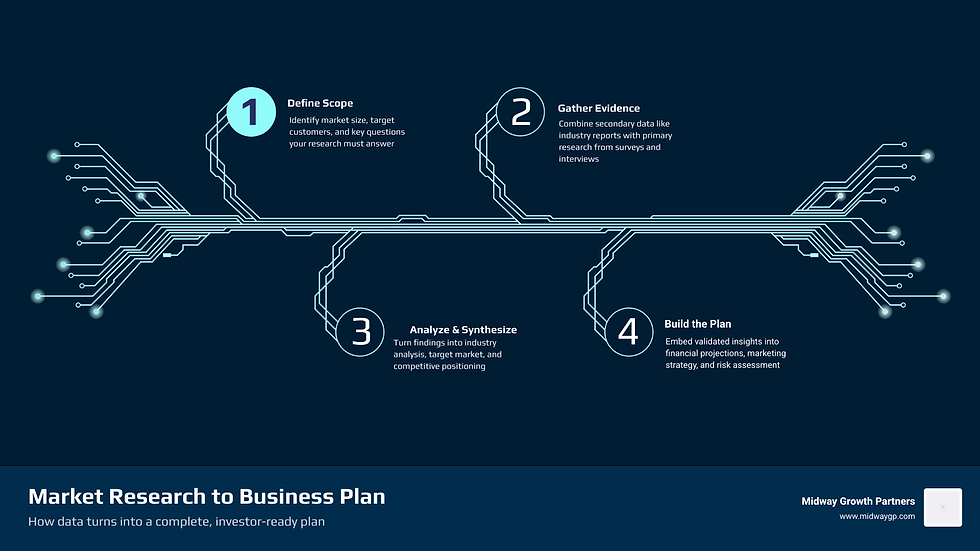
Good research does not have to be fancy. It does need to be disciplined. We recommend a lean process: start broad with existing data, then validate your biggest assumptions with primary research.
Start with secondary research to size the market
Secondary research is existing information gathered by someone else. It is usually the fastest place to start and often surprisingly useful.
Common sources include:
U.S. Census data
Bureau of Labor Statistics data
Industry associations
Public filings and company websites
Economic indicators
Local and regional business resources
Internal sales and CRM data
Use this stage to answer:
How large is the market?
Is it growing, shrinking, or shifting?
What trends are shaping customer behavior?
Are there regulatory or technology changes to watch?
What does a realistic serviceable market look like?
This is where TAM, SAM, and SOM help:
TAM: total addressable market
SAM: serviceable available market
SOM: serviceable obtainable market
Your investors do not want to hear that the total market is huge if your realistic obtainable slice is tiny and undefined.

For a practical starting point, public small-business resources like Research Your Market and Create a Business Plan can help organize the basics.
Use primary research to validate demand and pricing
Secondary data gives context. Primary research tells you whether people actually care.
Useful methods include:
Customer interviews
Online surveys
Focus groups
Observation
Message testing
Pricing or willingness-to-pay testing
Primary research is where you test assumptions such as:
Which problem feels urgent to buyers?
Which feature matters most?
What objections stop purchase?
What pricing feels too cheap, fair, or too expensive?
Which message gets attention?
A few rules matter here:
Ask unbiased questions
Use a representative sample where possible
Do not rely only on people who already like you
Focus on behavior, not just opinions
"What would you pay?" can be useful. "What did you last pay for a similar solution?" is often better.
Cost-effective market research for startups and small businesses
You do not need a giant budget to produce a credible plan. In fact, many small businesses can get strong early insights with simple methods.
Low-cost research methods:
Interview 10 to 20 potential customers
Review lost deals and sales notes
Analyze website traffic and search behavior
Study online reviews for competitors and substitutes
Mine customer support questions for recurring pain points
Run short surveys to an email list
Use social listening to spot complaints and unmet needs
Visit a local library for industry databases
Pull public economic and labor data
Review CRM, proposal, and conversion data
This matters because research can get expensive fast. Focus groups and formal studies can cost thousands. For early-stage planning, lean methods are usually enough to test your biggest assumptions before investing more.
Common mistakes that weaken a business plan
We see the same errors over and over:
Confirmation bias: looking only for data that proves your idea is brilliant
Stale data: using old reports for a fast-moving market
Surveying friends: they love you, not objectivity
Vague segments: "small businesses" is not a target market
Overestimating demand: assuming awareness equals purchase
Ignoring substitutes: your real competition may be "do nothing"
Unverified AI output: useful for speed, risky if not checked against real sources
AI can help summarize, organize, and brainstorm research, but as of May 2026, it should never be treated as evidence on its own.
The 3 Analyses That Make Your Plan Credible
A credible market analysis usually rests on three pillars: industry analysis, target market analysis, and competitive analysis. Together, they show where you are playing, who you are serving, and how you can win.
Industry analysis: size, growth, trends, and barriers
Industry analysis looks at the broader category your business enters.
Typical questions include:
What is the current market size?
What is the growth rate?
Which trends are reshaping demand?
Which NAICS category best fits the business?
Are regulation, technology, or labor trends changing the economics?
What barriers to entry exist?
Important barriers might include:
Capital requirements
Licensing or compliance requirements
Long sales cycles
Brand trust
Distribution access
Specialized talent needs
The goal is not to dump statistics into your plan. It is to explain what the data means for your business model.
Target market analysis: who buys, why they buy, and how much they spend
This section turns "the market" into actual people.
A strong target market analysis covers:
Demographics or firmographics
Geography
Buying behavior
Motivations and pain points
Purchase triggers
Budget range
Decision criteria
Preferred channels
We usually recommend segmenting before projecting. One product can appeal to multiple segments, but not equally well. Some have urgent pain. Some have bigger budgets. Some are easier to reach.
A simple persona snapshot might include:
Role or life stage
Primary problem
Current workaround
Buying trigger
Top objection
Preferred channel
Expected spend range

The more clearly you define the customer, the easier it becomes to build marketing, sales, and pricing that actually fit.
Competitive analysis in a market research business plan
Competitive analysis is not just a list of rivals. It is a map of alternatives.
Look at:
Direct competitors
Indirect competitors
Substitute solutions
Positioning
Distribution channels
Customer sentiment in reviews
Perceived strengths and weaknesses
Research should help answer:
Where are competitors strong?
Where are customers dissatisfied?
What white space exists?
What is hard to copy?
What might force a price war?
Good competitive analysis also keeps you honest. If three alternatives already solve the problem well enough, your plan needs a stronger differentiation story.
How market research business plan findings shape positioning
Positioning is where the research becomes strategy.
When you understand market gaps, buyer priorities, and competitor weaknesses, you can define:
Your value proposition
Your best-fit customer segment
Your key message
Your pricing posture
Your go-to-market channel mix
In other words, market research tells you not just whether the opportunity exists, but how to present your offer so it resonates. If you want help turning analysis into action, our services are built for exactly that.
Turning Research Into Revenue, Pricing, and Financial Projections
This is where many business plans wobble. The market analysis sounds thoughtful, then the financials suddenly leap into fantasy. Research should bridge that gap.
Estimate market size, demand, and realistic share
Use both top-down and bottom-up forecasting.
Top-down starts with total market size, then narrows to your segment and likely capture. Bottom-up starts with operational reality: leads, conversion rates, deal size, and capacity.
A realistic forecast uses both.
For example:
Start with the number of target buyers in your launch market
Estimate how many match your ideal customer profile
Apply a conservative awareness and conversion rate
Multiply by expected spend
If 25,000 potential buyers exist in a launch area and 10% show likely purchase intent, that creates a starting demand pool. Your actual Year 1 forecast should still assume only a modest share of that pool.
Conservative assumptions are not boring. They are fundable.
Build pricing using customer research and competitor signals
Pricing should reflect three things:
What customers value
What alternatives cost
What margins your model requires
Research can support pricing through:
Interviews about current spending
Survey-based price sensitivity testing
Competitor pricing review
Offer comparisons and bundle analysis
Purchase behavior from pilot programs
This helps you decide whether to lead with premium, value, or middle-market positioning. High prices can work, but only if the experience, trust, and outcomes feel worth it. Cheap pricing can attract attention, but it can also damage perceived quality or destroy margins.
Let research drive financial projections and risk assessment
A good financial model should connect directly to market evidence.
That means using research to inform:
Revenue forecasts
Customer acquisition assumptions
Churn expectations
Pricing tiers
Sales cycle length
Gross margin assumptions
Break-even timing
Downside scenarios
Some template examples in the research show aggressive revenue growth and EBITDA turning positive in Year 2. Those figures may be possible in specific business models, but the larger lesson is more important: financial projections should be tied to real assumptions that can be explained and defended.
We also recommend scenario planning:
Base case
Conservative case
Upside case
Then link each case to named risks such as slower adoption, lower pricing, higher churn, or delayed sales capacity. For a deeper view on how research supports business plan development, see The Role Of Market Research In Business Plan Development.
A simple market analysis example you can adapt
Here is a simplified example structure:
Industry snapshot: growing consulting niche with rising demand for data-backed planning
Target persona: operations or growth leader at a midsize firm needing better forecasting
Competitor gap: many options offer generic advice, few combine strategy with execution rigor
Pricing logic: premium over basic providers, justified by measurable outcomes and decision support
Year 1 forecast: based on target account count, outreach rate, close rate, and average contract value
Risk register: longer sales cycle, weak differentiation, pricing resistance, delivery bottlenecks
If you want a fill-in framework, a market research business plan template with financials can help you structure the document faster.
Templates, Tools, and Update Cadence for an Ongoing Plan
A business plan is not a museum piece. It should evolve as your market changes.
Useful tools and resources to build your plan faster
Helpful tools and resources include:
Survey platforms
CRM data exports
Website analytics tools
Search trend tools
Review aggregation sites
U.S. Census data
Bureau of Labor Statistics data
Trade association reports
Local library databases
Small business planning resources
A few useful references:
The right toolkit depends on your stage. Early on, simplicity wins. Later, dashboards and automated reporting become more valuable.
How often should market research be updated?
Not once a year and definitely not never.
A practical cadence looks like this:
Monthly: monitor signals like traffic, lead quality, competitor moves, reviews, and pricing changes
Quarterly: review customer segments, messaging, pipeline conversion, and forecast assumptions
Annually: refresh market size, trend analysis, competitor landscape, and strategic priorities
Also update your research when trigger events happen:
Product launch
Expansion into a new market
Major pricing change
New competitor entry
Demand slowdown
Regulatory or technology shift
The more uncertain the market, the more frequently you should revisit the plan.
A practical template for your market analysis section
Use this simple structure for the market analysis section of your business plan:
Research summary
Market definition
Industry size and growth
Trends and barriers
Target customer segments
Buyer personas
Demand signals
Competitive matrix
Pricing insights
Forecast assumptions
Risks and mitigation
Next actions
Prompts to guide the section:
Who exactly is the customer?
What problem are they trying to solve?
How are they solving it today?
How large is the reachable market?
Why is now a good time to enter?
Who else is competing for the same budget?
What pricing is realistic?
What assumptions matter most?
What would cause the plan to change?
Frequently Asked Questions about Market Research Business Plan
How do you write the market research section of a business plan?
Start with secondary research to define the market, size it, and identify trends. Then use primary research to validate customer pain points, demand, and pricing. Organize the findings into industry analysis, target market analysis, competitive analysis, and forecast assumptions. Keep it concise, evidence-based, and directly tied to business decisions.
Helpful references include Business Plan Market Analysis - TheBusinessProfessor and How to Conduct a Market Analysis for Your Business in 4 Steps | LivePlan.
Can a small business create a strong market research business plan without a big budget?
Yes. Small businesses can produce a strong plan using public data, customer interviews, internal sales information, website analytics, and structured competitor review. You do not need an expensive custom study to validate an early business case. You do need discipline, clear questions, and honest interpretation of results.
What data matters most to investors and lenders?
Usually these five:
Clear evidence of market demand
A well-defined target customer
Credible competitive positioning
Rational pricing logic
Financial projections tied to market reality
They want to know there is a real opportunity, a believable path to revenue, and a management team that understands risk.
Conclusion
A great business plan does not begin with spreadsheets. It begins with evidence.
If you want your market research business plan to be more than a document that looks impressive in a PDF, build it from the market outward: industry facts, customer insight, competitive reality, pricing logic, and financial assumptions that can survive tough questions.
That is how we reduce guesswork, improve investor readiness, and create plans that are actually usable after the meeting ends.
If you want help building a smarter plan, explore our services, read more on revenue growth strategy, or browse our blog for practical planning insights.


